Four Points Express by Sheraton
Bringing a global hotel brand home in Chinese
This project was delivered as part of my work at Prophet. The project was co-developed by the design & strategy team in Hong Kong. The content presented here reflects my personal contribution and learning within that collaborative context.
Project Type
Localisation, Naming Strategy, Branding
Year
2023
Origin
China
Client / Collaborator
Marriott International
Role
Designer
Marriott International was expanding its portfolio into the APAC market with Four Points Express by Sheraton, a select-tier hotel brand designed to offer quality-conscious travellers a more accessible alternative to full-service hotels. To compete meaningfully in one of the world's most competitive hospitality markets, the brand needed more than a translation. It needed a Chinese identity that could feel native to its market while remaining unmistakably Four Points. As part of the team at Prophet, I worked as a designer on the brand localisation project, helping to develop the Chinese naming architecture, a bilingual logo lockup, and a localised signage system built for APAC audiences.

THE CHALLENGE
The APAC hospitality market is highly competitive, with local and international brands fighting for the same select-tier positioning. For Four Points Express to land well, it had to feel both global and locally rooted. Alongside the strategic challenge, there were practical constraints that shaped our process. Travelling to APAC to audit competitor signage in person was not feasible, so our competitive research had to be conducted remotely. Identifying the right typologies of hotel signage from digital sources alone required careful methodological thinking. Pinpointing the difference between a plaque, a porte cochere sign, and an entry signage panel without seeing them in context turned out to be more genuinely difficult than expected, and it pushed us to be precise and rigorous in how we categorised and documented our findings.
NAMING STRATEGY
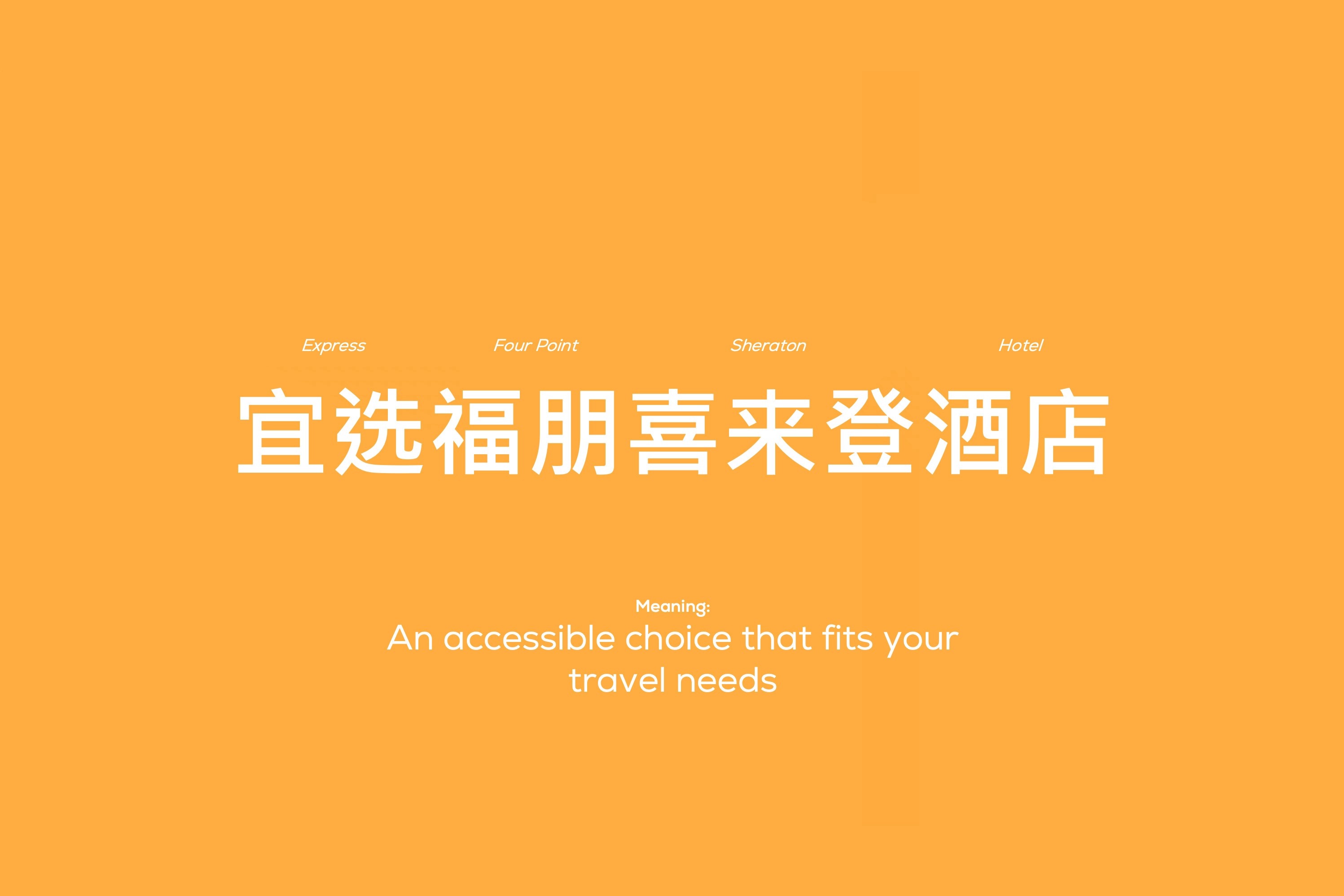
Naming a hotel brand for a Chinese audience is not simply a transliteration exercise. The name needs to function phonetically, carry appropriate meaning, and sit correctly within the competitive landscape. For Four Points Express by Sheraton, we developed the Chinese name 宜选福朋喜来登酒店. The tier descriptor 宜选 was central to this decision. 宜 carries associations of suitability and accessibility, with a phonetic echo of "Express" that creates an intuitive link to the English brand name. It also evokes 宜家 (IKEA), whose brand positioning of accessible quality aligns closely with what Four Points Express was trying to communicate. The character 选 signals selection and discernment, clarifying the brand's place in Marriott's tiered portfolio without needing to spell it out. Together, 宜选 functioned as both a naming marker and a quiet positioning statement.

VISUAL DESIGN
Bilingual logo lock-up –
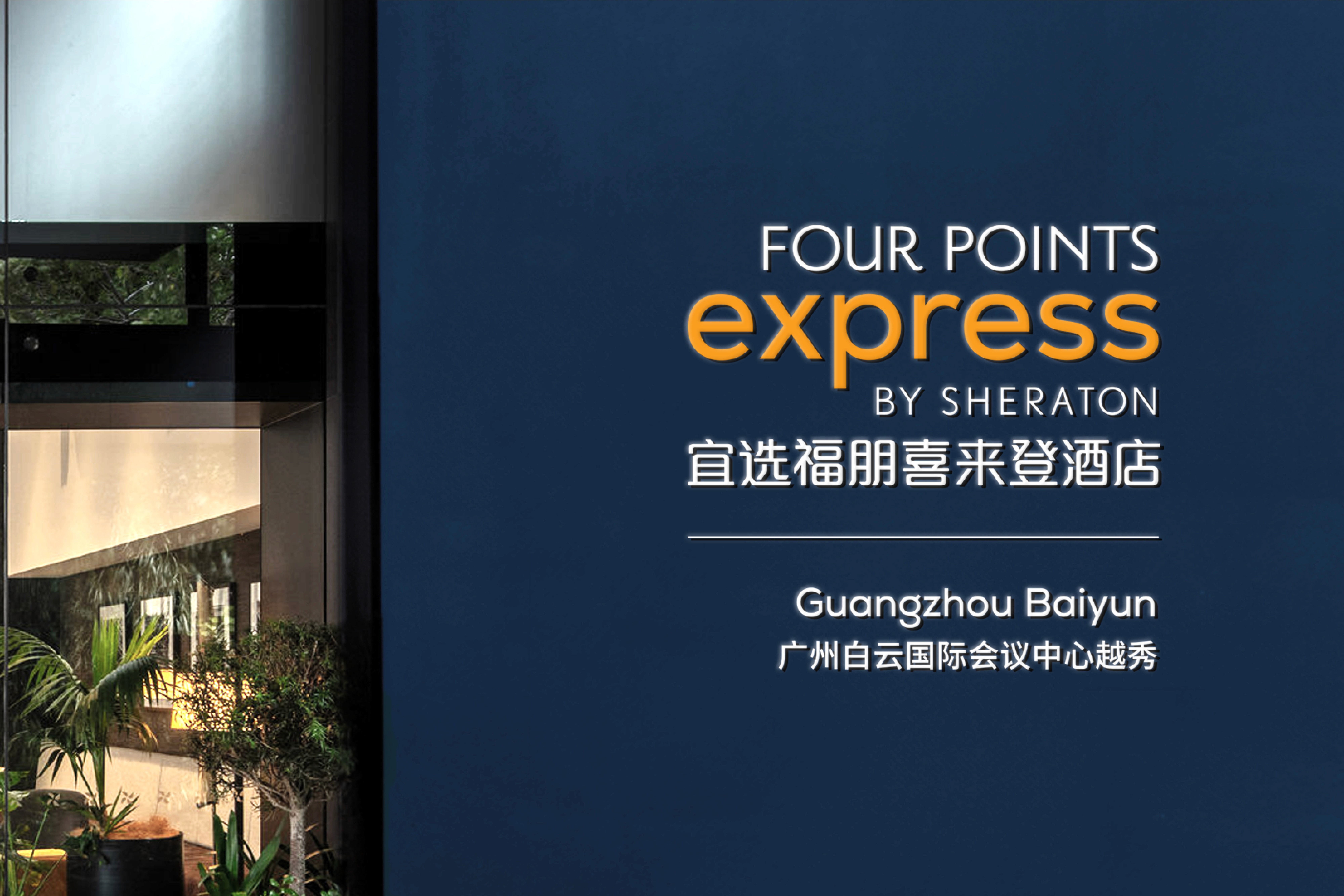
With the Chinese name established, the next challenge was integrating it into a bilingual logo lockup that felt cohesive with the existing Four Points Express English master logo. Working within the established brand guidelines, we were not creating a new visual language from scratch. The task was to extend it faithfully into a Chinese context. We studied the defining characteristics of the English logotype closely: the slanted terminals referencing the diagonal thrust of the "X" in Express, the even stroke weight, the rounded corners, and the steady grounded baseline. Rather than sourcing an off-the-shelf typeface that approximated these qualities, we carved and refined the Chinese characters on top of a base typeface to make them genuinely connected to the English logotype. The result was a bilingual lockup that reads as one unified typographic identity rather than two scripts placed side by side.
Localised signage –
Developing the signage system required us to first define what signage types were relevant for the APAC hotel context. Through remote competitive auditing, we identified four key typologies: building signage, horizontal entry signage, vertical entry signage, and porte cochere signage. Each serves a distinct wayfinding and brand communication role. The design challenge was ensuring the bilingual lockup worked across all formats, from the large-scale building plaque to the porte cochere where the logo and a location descriptor needed to coexist legibly. Every application was designed to maintain visual hierarchy and brand clarity, whether a guest was reading in English or Chinese.

RESULT & LEARNING
The project delivered a Chinese brand identity system for Four Points Express by Sheraton that extended the global brand into the APAC market with strategic intentionality rather than surface-level adaptation. Working under the constraint of remote research taught me to be more rigorous in how I documented and verified design decisions, particularly when firsthand observation was not an option. It also reinforced how much naming matters. Choosing 宜选 was not a typographic decision but a positioning one, and getting that right shaped everything that followed.
Next Projects